Logo AnimGAnimG

Biblioteca animazioni

Animazioni selezionate, create e gestite dal team AnimG.

Pubblico:
Categoria:
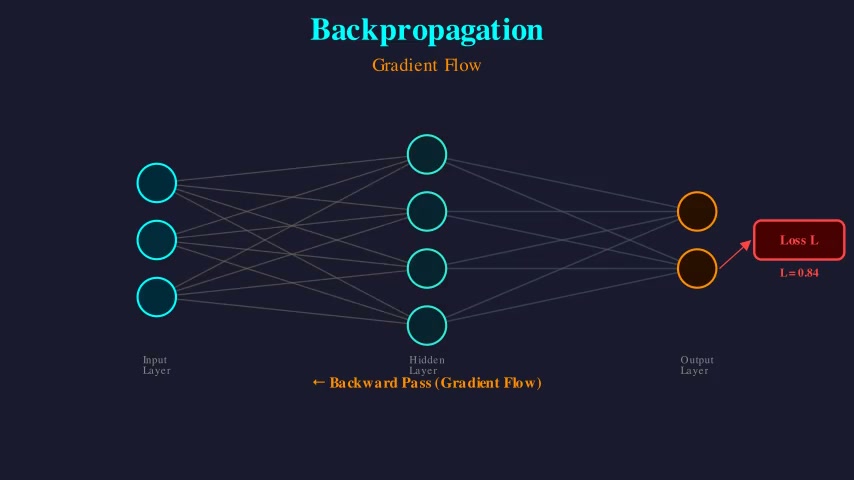
Backpropagation — Gradient Flow

Backpropagation — Gradient Flow

Demonstrates backpropagation in a 3-layer neural network. A forward pass first computes activations left to right, then a loss is computed. Gradients flow backward through the network as a glowing wave, with the chain rule applied at each layer. The key partial derivative formula is displayed.

Software EngineerCs
Binary Trees — Insert, Search, AVL Balance

Binary Trees — Insert, Search, AVL Balance

Demonstrates binary search tree operations step by step: inserting nodes to build a BST, searching for a value with left/right comparisons shown, detecting an unbalanced tree, and performing an AVL left rotation to restore balance. Height and balance factor labels update throughout.

Software EngineerCs
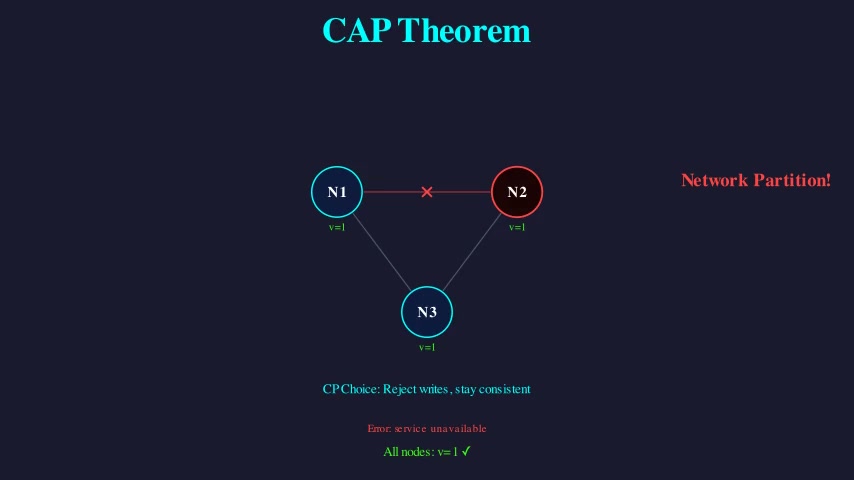
CAP Theorem

CAP Theorem

Explains the CAP theorem through an animated distributed system with 3 nodes. A network partition is triggered, and the animation shows the trade-off: choosing CP sacrifices availability while choosing AP allows divergence. Real-world systems are labeled with their CAP classification.

Software EngineerCs
Consistent Hashing

Consistent Hashing

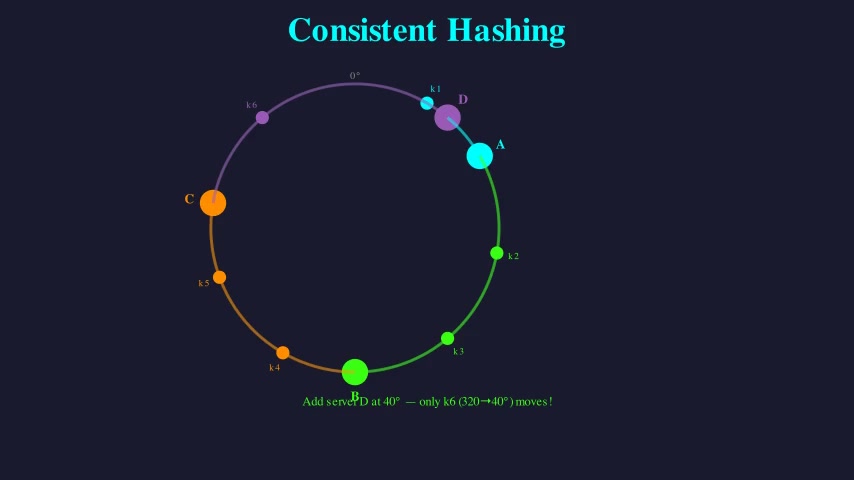
Demonstrates consistent hashing on a circular hash ring (0–360 degrees). Server nodes are placed on the ring, keys are assigned clockwise, and the animation shows that adding or removing a server only redistributes a minimal fraction of keys. Virtual nodes are introduced to improve load distribution.

Software EngineerCs
Dijkstra's Shortest Path

Dijkstra's Shortest Path

Visualizes Dijkstra's algorithm on a weighted directed graph with 6 nodes. The animation shows the priority queue (min-heap), greedy node exploration, distance table updates at each step, and the final shortest path tree highlighted in gold.

Software EngineerCs
Dynamic Programming — Fibonacci & Memoization

Dynamic Programming — Fibonacci & Memoization

Contrasts three approaches to computing Fibonacci numbers: naive recursion (exponential, showing repeated subproblems in red), top-down memoization (cached calls return instantly in green), and bottom-up DP table filling. Complexity labels O(2^n) vs O(n) are displayed prominently.

Software EngineerCs
Git Internals — DAG of Commits

Git Internals — DAG of Commits

Visualizes Git's underlying commit DAG structure. Commit objects are shown as circles with abbreviated hash IDs, branches as colored labels pointing to commits, and HEAD as a special pointer. Operations animated include: git commit (new node), git branch (new label), git merge (merge commit with two parents), and git rebase (commits replayed on new base).

Software EngineerCs
Merge Sort — Divide, Conquer, Merge

Merge Sort — Divide, Conquer, Merge

Visualizes the classic merge sort algorithm on an 8-element array [5,3,8,1,9,2,7,4]. The animation shows the recursive divide phase as a tree splitting down to individual elements, then the merge phase rebuilding sorted subarrays from the bottom up. Complexity is displayed as O(n log n).

Software EngineerCs
Neural Network Forward Pass

Neural Network Forward Pass

Visualizes a forward pass through a [3, 4, 4, 2] neural network. Input activations propagate layer by layer through weighted connections, showing the weighted sum computation and activation function at each layer. The output layer applies softmax. Active neurons glow to indicate high activation values.

Software EngineerCs
Quicksort — Pivot Partitioning

Quicksort — Pivot Partitioning

Demonstrates the quicksort algorithm on an unsorted array using in-place pivot partitioning. Shows the two-pointer sweep with elements being classified relative to the pivot, the pivot landing in its final sorted position, and recursive application to subarrays. Displays both average and worst-case complexities.

Software EngineerCs
RSA Encryption

RSA Encryption

Walks through the RSA public-key cryptosystem: key generation from two primes, encryption using the public key, and decryption using the private key. Alice and Bob exchange an encrypted message, demonstrating the one-way trapdoor function. The security relies on the hardness of integer factorization.

Software EngineerCs
TCP Three-Way Handshake

TCP Three-Way Handshake

Animates the complete TCP connection lifecycle between a client and server: the three-way handshake (SYN, SYN-ACK, ACK), data transfer phase, and four-way connection teardown (FIN, ACK, FIN, ACK). Each packet is labeled with its flags and sequence/acknowledgment numbers, and a timeline diagram tracks the full exchange.

Software EngineerCs
Transformer Self-Attention

Transformer Self-Attention

Visualizes the scaled dot-product self-attention mechanism in a Transformer. Input tokens are projected to Q, K, V matrices, attention scores are computed via Q×K^T dot products shown as a heatmap, softmax is applied, and the output is computed as a weighted sum with V. The full attention formula is displayed.

Software EngineerCs
Compound Interest — Exponential Growth

Compound Interest — Exponential Growth

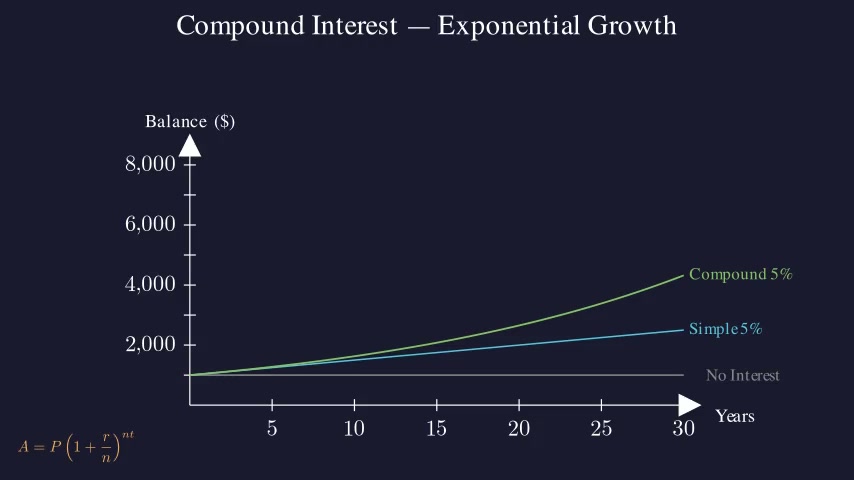
Demonstrates the power of compound interest by comparing three growth scenarios over 30 years: no interest (flat), simple interest at 5% (linear), and compound interest at 5% (exponential). Illustrates the compounding formula and a concrete $1000 @ 7% example showing $7,612 after 30 years.

High SchoolEconomics
Inflation — Purchasing Power Over Time

Inflation — Purchasing Power Over Time

Illustrates how inflation erodes purchasing power over time through multiple visual metaphors: a shrinking coin, a bar chart showing how many goods $100 buys across decades, the rising CPI index, and the Rule of 72 applied to purchasing power halving at 3% annual inflation (~24 years).

High SchoolEconomics
Supply & Demand Curves

Supply & Demand Curves

Visualizes how supply and demand curves interact to form a market equilibrium. Demonstrates the effects of a demand shift (rightward) and a supply shift (leftward) on equilibrium price and quantity, building core microeconomics intuition.

MiddleEconomics
Game Theory — Prisoner's Dilemma

Game Theory — Prisoner's Dilemma

Introduces the Prisoner's Dilemma, a foundational concept in game theory. Shows a 2x2 payoff matrix, animates two prisoners making independent decisions, explains why (Defect, Defect) is the Nash Equilibrium even though mutual cooperation is Pareto superior. Highlights dominant strategies and the Nash Equilibrium condition.

UniversityEconomics
Network Effects — Metcalfe's Law

Network Effects — Metcalfe's Law

Demonstrates network effects by visually building a graph of nodes and edges as users are added one by one. Shows that connections grow quadratically as n(n-1)/2, contrasting linear cost of new users with the quadratic growth in network value (Metcalfe's Law: V ∝ n²). Includes real-world examples like telephone networks and social media.

UniversityEconomics
Option Pricing — Black-Scholes

Option Pricing — Black-Scholes

Visualizes the Black-Scholes option pricing model through three key concepts: geometric Brownian motion stock paths, the call option payoff diagram at expiry (max(S-K, 0)), and the probability cone expanding over time. Shows how volatility sigma affects option price and presents the full Black-Scholes formula.

UniversityEconomics
Geometric Series

Geometric Series

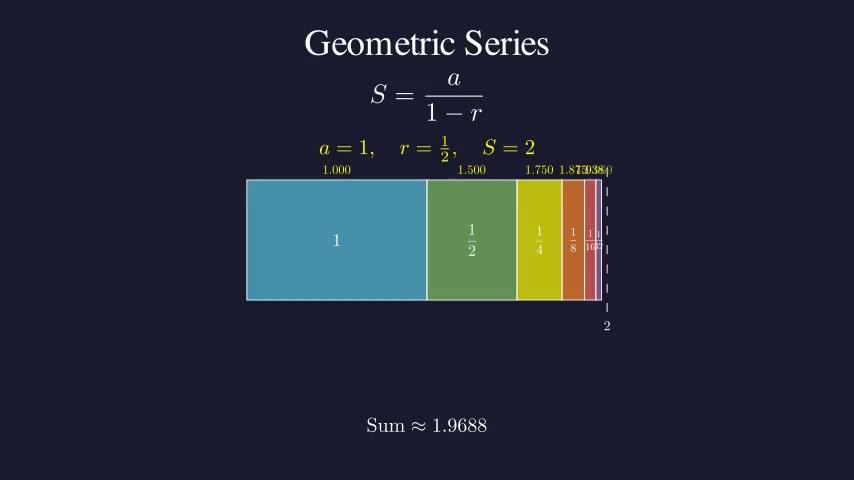
This animation visualizes the infinite geometric series 1 + 1/2 + 1/4 + 1/8 + ... by repeatedly halving a unit square. Each term is shown as a filled rectangle that fits beside the previous ones like puzzle pieces, and the partial sums are displayed numerically, all converging toward the limit of 2.

High SchoolMath
Linear Functions: Slope & Y-Intercept

Linear Functions: Slope & Y-Intercept

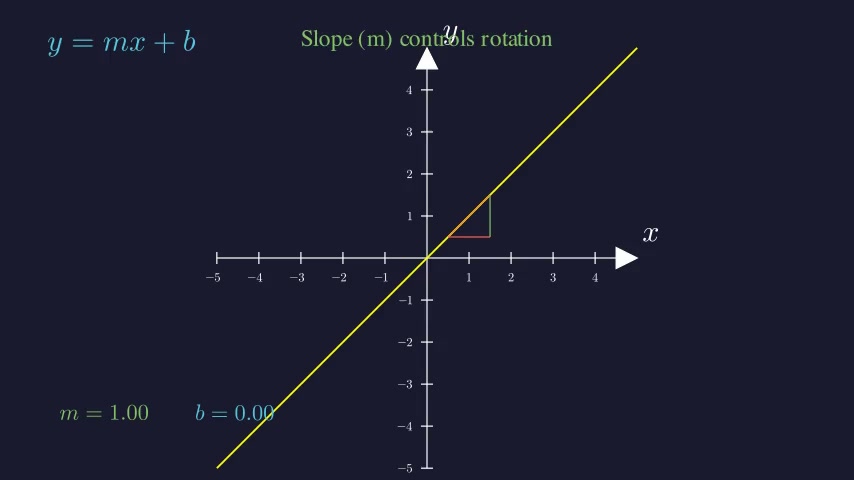
This animation introduces linear functions of the form y = mx + b by visually demonstrating how the slope (m) and y-intercept (b) affect the graph. A line rotates as the slope changes from -2 to 2, then shifts vertically as the intercept changes from -3 to 3. A rise/run right-triangle indicator reinforces the geometric meaning of slope.

High SchoolMath
Logarithms: Inverse of Exponential

Logarithms: Inverse of Exponential

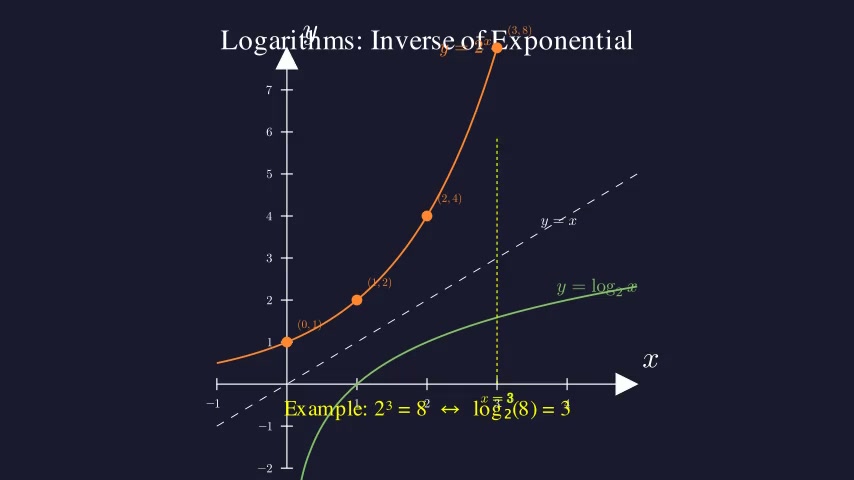
This animation establishes the relationship between exponential and logarithmic functions. It plots y = 2^x and y = log₂(x) side-by-side reflected across y = x, demonstrating inverse symmetry. A concrete numeric example (2³ = 8 → log₂(8) = 3) is shown with perpendicular guide lines, making the inverse relationship tangible.

High SchoolMath
Permutations vs Combinations

Permutations vs Combinations

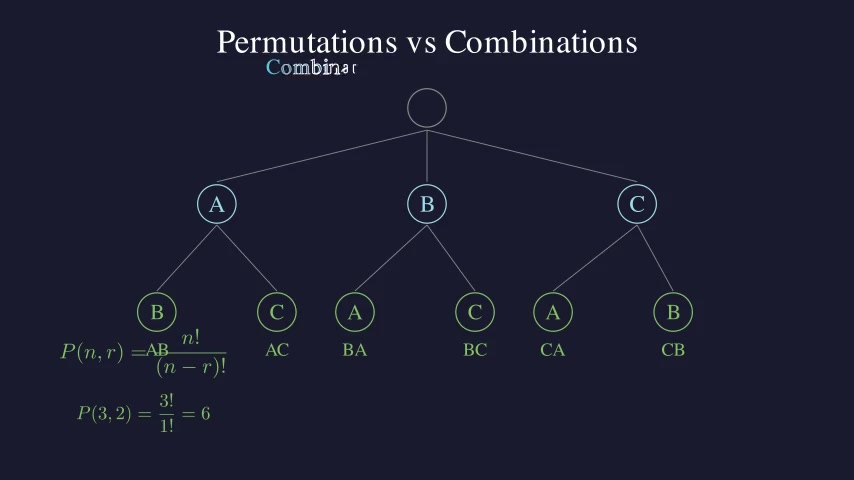
This animation contrasts permutations (order matters) with combinations (order doesn't matter) using a concrete example of choosing 2 items from {A, B, C}. A tree diagram visually enumerates all 6 permutations, then groups are collapsed to show only 3 combinations, making the divide-by-r! factor intuitive.

High SchoolMath
Deriving the Quadratic Formula

Deriving the Quadratic Formula

This animation walks through the algebraic derivation of the quadratic formula by completing the square step-by-step. Each line of algebra appears via a MathTex Write or TransformMatchingTex animation, building from ax² + bx + c = 0 all the way to x = (-b ± √(b²-4ac)) / 2a. The discriminant is highlighted in a distinct color to emphasize its role.

High SchoolMath
The Quadratic Parabola

The Quadratic Parabola

This animation explores the standard form of a quadratic y = ax² + bx + c by animating each coefficient. Students see how 'a' controls width and direction, 'c' shifts the parabola vertically, and the vertex traces a path as parameters change. The formula updates in real time alongside the graph.

High SchoolMath
Trigonometry & the Unit Circle

Trigonometry & the Unit Circle

This animation shows the unit circle definition of sine and cosine. A point traces the circle as angle θ sweeps from 0 to 2π. Vertical (sin) and horizontal (cos) projections are drawn in real time. Simultaneously, sin and cos waves trace out on a graph panel to the right, creating an intuitive visual connection between circular motion and wave graphs.

High SchoolMath
Vectors in 2D

Vectors in 2D

This animation introduces 2D vectors through visual demonstrations on a number plane. It shows a vector as an arrow, demonstrates scalar multiplication (stretching/shrinking), and vector addition using the tip-to-tail method. Component form and magnitude formula are displayed with MathTex.

High SchoolMath
Area of Triangle and Circle

Area of Triangle and Circle

Derives the area formulas for a triangle and a circle using visual proofs. Students see that a triangle is half a rectangle (A = ½bh), and that a circle can be rearranged into a near-rectangle whose dimensions involve π and r (A = πr²).

MiddleMath
The Cartesian Coordinate System

The Cartesian Coordinate System

Introduces the Cartesian coordinate system by drawing labeled x and y axes with gridlines, then plotting four points across all four quadrants. For each point, dashed guide lines reveal how to read x and y coordinates.

MiddleMath
Introduction to Variables

Introduction to Variables

Uses the metaphor of a "mystery box" to explain that a variable is a placeholder that can hold different values. Students see the same expression x + 2 evaluated for x = 3 and x = 7, building intuition before formal algebra.

MiddleMath
Negative Numbers on the Number Line

Negative Numbers on the Number Line

Introduces negative numbers by showing a number line from -10 to +10 and demonstrating that numbers extend to the left of zero. Students see that negative and positive numbers are mirror images, then practice addition and subtraction using animated hops.

MiddleMath
Percentages

Percentages

Builds understanding of percentages by shading a 10×10 grid and connecting it to fractions and decimals. A real-world discount example (20% off $50) anchors the concept in everyday math.

MiddleMath
Prime Factorization

Prime Factorization

Animates factor trees for 60 and 84, showing how any composite number can be broken down into a unique product of prime numbers. Prime numbers are highlighted in distinct colors and the final exponential form is displayed with MathTex.

MiddleMath
The Pythagorean Theorem

The Pythagorean Theorem

Presents the visual square-area proof of the Pythagorean Theorem using a 3-4-5 right triangle. Students see squares growing on each side and observe that the two smaller areas add up to the largest area, giving intuition for a² + b² = c².

MiddleMath
Ratios & Proportions

Ratios & Proportions

Demonstrates ratios using colored bars and shows how proportional scaling maintains the ratio. A recipe context (flour to sugar) makes the concept concrete and relatable for middle schoolers.

MiddleMath
Addition & Subtraction on a Number Line

Addition & Subtraction on a Number Line

Show a number line from 0 to 20 with a colorful arrow hopping right for addition and left for subtraction. Two worked examples are shown: 5+3=8 (three hops right) and 8-3=5 (three hops left). Each hop is animated individually with equation labels updating live.

PrimaryMath
Reading a Clock

Reading a Clock

An analog clock face is shown and the hour and minute hands rotate to display three times: 3:00, 6:30, and 9:15. Each time the hands arrive at the correct position a digital time label appears next to the clock so students connect the analog position to the digital reading.

PrimaryMath
Counting with Dots

Counting with Dots

A visual introduction to counting for primary school students (ages 6–11), using animated dot groups on a number line to build number sense and subitizing skills. The animation shows dots appearing in groups, connecting visual quantity to numerals 1–10.

PrimaryMath
Fractions as Sliced Shapes

Fractions as Sliced Shapes

A circle (pizza) is cut into equal slices to illustrate 1/2, 1/3, and 1/4. Each cut animates as a growing line, then one highlighted slice shows the fraction label. A rectangle is also split into halves for a second visual.

PrimaryMath
Multiplication as Repeated Groups

Multiplication as Repeated Groups

Demonstrates multiplication as repeated equal groups using colored dot arrays. Two examples are shown: 3×4 (three groups of four) and 2×5 (two groups of five). Groups appear one at a time, then dots rearrange into a neat grid with the equation label.

PrimaryMath
Perimeter vs Area

Perimeter vs Area

A rectangle is shown on screen. The perimeter is demonstrated by a dot walking around all four sides while a counter adds up each side length. The area is then shown by filling the interior with a grid of unit squares, one column at a time. Both results are labeled with their standard formulas.

PrimaryMath
Place Value: Ones, Tens, Hundreds

Place Value: Ones, Tens, Hundreds

Introduces the concept of place value using visual blocks. A single small square represents 1 (ones), a row of 10 squares represents 10 (tens), and a 10×10 grid represents 100 (hundreds). The number 234 is built step-by-step.

PrimaryMath
Shapes & Symmetry

Shapes & Symmetry

Four common polygons (triangle, square, pentagon, hexagon) are introduced one at a time. For each shape a dashed symmetry line is drawn and the shape is reflected across it. The square also demonstrates rotational symmetry with a spin animation.

PrimaryMath
Central Limit Theorem

Central Limit Theorem

Demonstrates the Central Limit Theorem by starting with a non-normal (uniform) population, then repeatedly drawing samples of size n=30 and computing their means. As more sample means are collected, the histogram of means converges to a bell curve regardless of the original distribution's shape.

UniversityMath
The Chain Rule

The Chain Rule

Visualizes the chain rule through three stacked number lines representing the input x, the intermediate value g(x), and the output f(g(x)). Animated small changes Δx propagate through the composition, making the multiplicative structure of the chain rule visually intuitive.

UniversityMath
Complex Numbers as Rotations

Complex Numbers as Rotations

Shows the complex plane as a geometric framework where multiplication by i corresponds to a 90-degree rotation. Builds up to Euler's formula e^(iθ) as a general rotation, culminating in the famous identity e^(iπ) = -1.

UniversityMath
Derivatives: The Tangent Line

Derivatives: The Tangent Line

Builds intuition for the derivative by animating the limit definition. A secant line between two points on f(x) = x² is drawn and animated as h approaches 0, visually converging to the tangent line. The difference quotient formula transforms into the derivative formula.

UniversityMath
Eigenvalues & Eigenvectors

Eigenvalues & Eigenvectors

Demonstrates the geometric meaning of eigenvalues and eigenvectors by applying a 2D linear transformation to the plane and contrasting how most vectors rotate and stretch while eigenvectors only stretch along their own span. The equation Av = λv is derived visually.

UniversityMath
Fourier Series

Fourier Series

Demonstrates how a square wave can be decomposed into and reconstructed from sine waves. Individual harmonic components animate in one by one, and the running partial sum curve updates to show convergence toward the square wave.

UniversityMath
Matrix Transformations in 2D

Matrix Transformations in 2D

Visualizes how 2x2 matrices transform the plane by animating a NumberPlane grid through four key transformations: identity, 90-degree rotation, shear, and stretch. The basis vectors i-hat and j-hat are highlighted to show how the matrix columns determine the transformation outcome.

UniversityMath
Probability Distributions

Probability Distributions

Introduces three fundamental probability distributions — Normal, Binomial, and Poisson — with visual representations and key formulas. For the Normal distribution, the 68-95-99.7 empirical rule is animated by progressively shading regions under the bell curve.

UniversityMath
Riemann Sums → Definite Integral

Riemann Sums → Definite Integral

Visualizes how Riemann sums approximate the definite integral by increasing the number of rectangles under f(x) = x² from 0 to 3. As n grows from 4 to 32, the approximation converges to the exact area of 9, illustrating the limit definition of the integral.

UniversityMath
Taylor Series Approximation

Taylor Series Approximation

Demonstrates how the Taylor series builds increasingly accurate polynomial approximations of cos(x) around x=0 by successively adding terms. Each new term is animated in a new color, revealing how the approximation extends further from the center.

UniversityMath
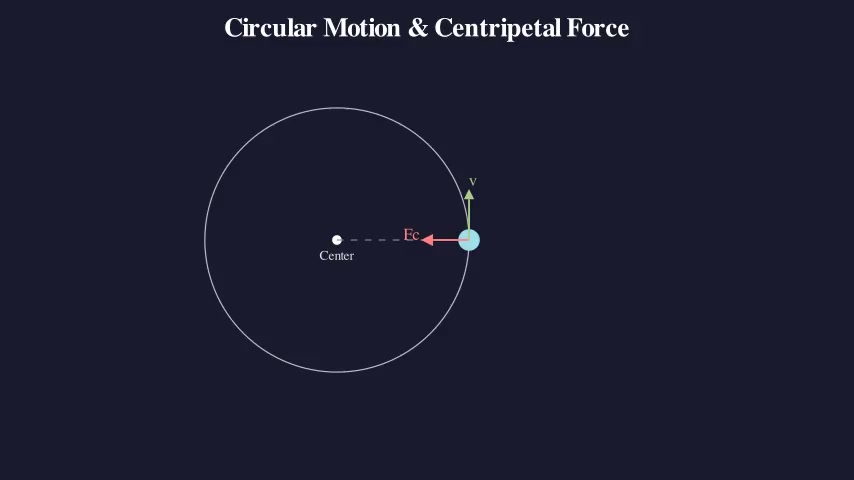
Circular Motion & Centripetal Force

Circular Motion & Centripetal Force

A ball on a string orbits in a circle. The velocity vector (tangent) and centripetal force vector (inward) are shown continuously updating. When the string breaks, the ball flies off tangentially, illustrating why centripetal force is required.

High SchoolPhysics
Conservation of Momentum

Conservation of Momentum

Two collision scenarios on a frictionless surface demonstrate momentum conservation. An elastic collision shows ball 1 stopping and ball 2 moving on. An inelastic collision shows the balls sticking together. Momentum vectors p = mv are shown before and after each collision.

High SchoolPhysics
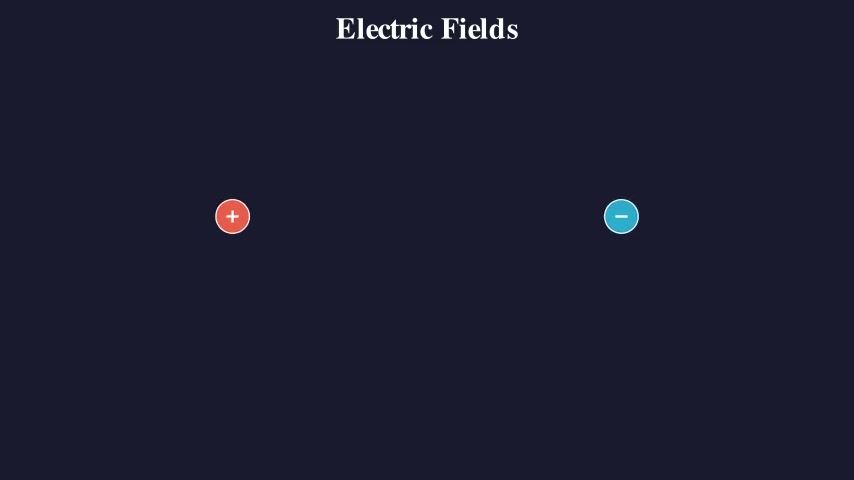
Electric Fields

Electric Fields

Electric field lines are shown radiating from a positive charge and converging on a negative charge. A dipole field shows lines flowing from + to -. A test charge placed in the field experiences a force along the field line direction.

High SchoolPhysics
Ohm's Law — V = IR

Ohm's Law — V = IR

A water pipe analogy introduces voltage, current, and resistance intuitively. A circuit diagram then shows these quantities. Increasing voltage drives more current. A V-I graph shows the linear relationship.

High SchoolPhysics
Projectile Motion

Projectile Motion

A projectile launched at an angle is decomposed into horizontal (constant velocity) and vertical (uniformly accelerated) components. The parabolic path is animated with a moving dot and changing velocity vector. Parametric equations are displayed.

High SchoolPhysics
Work & Energy: Potential → Kinetic

Work & Energy: Potential → Kinetic

A ball at height h rolls down a ramp, converting gravitational potential energy into kinetic energy. A synchronized bar chart shows PE decreasing and KE increasing while total mechanical energy remains constant.

High SchoolPhysics
Newton's First Law — Inertia

Newton's First Law — Inertia

A ball on a surface gradually stops due to friction; in frictionless space it rolls forever at constant speed. A car-braking inertia demo shows a passenger lurching forward. Label: "No net force = no change in motion."

MiddlePhysics
Newton's Second Law — F = ma

Newton's Second Law — F = ma

A block on a frictionless surface is pushed by a constant force. Three scenarios demonstrate that the same force produces less acceleration on heavier blocks and more acceleration on lighter blocks. The formula F = ma is displayed with numerical examples.

MiddlePhysics
Simple Machines

Simple Machines

Three simple machines are shown sequentially: a lever with fulcrum, a pulley system, and an inclined plane. Each demonstrates the force-distance trade-off — applying a smaller force over a greater distance accomplishes the same work.

MiddlePhysics
Speed vs Velocity

Speed vs Velocity

Two runners illustrate the difference between scalar speed and vector velocity. Runner A completes a circular lap returning to start (displacement = 0). Runner B travels in a straight line (displacement = distance). Direction makes velocity a vector.

MiddlePhysics
States of Matter

States of Matter

Colored circles represent atoms/molecules in solid, liquid, and gas states. Each state shows characteristic particle motion: tight vibration in solids, flowing in liquids, and fast random motion in gases. Heating transitions are animated.

MiddlePhysics
Wave Properties

Wave Properties

A transverse wave travels along a rope. Key wave properties — wavelength, amplitude, crest, and trough — are labeled. A ValueTracker drives time-dependent animation to show wave motion. The wave equation v = fλ is displayed.

MiddlePhysics
Gravity

Gravity

A visual introduction to gravity for primary school students (ages 6–11). Shows that all objects fall at the same rate regardless of weight, using animated objects dropping from height with equal timing. Key takeaway: heavier does NOT mean faster.

PrimaryPhysics
Light Reflection

Light Reflection

A bright yellow light ray strikes a mirror and reflects at an equal angle. The normal line and labeled angle arcs illustrate the law of reflection. A curved mirror then shows how parallel rays converge to a focal point.

PrimaryPhysics
Magnets & Magnetic Fields

Magnets & Magnetic Fields

Two bar magnets demonstrate attraction between opposite poles (N→S) and repulsion between like poles (N→N, S→S). Curved field lines visualize the invisible magnetic force. Animations are purely visual with no mathematics.

PrimaryPhysics
Sound as Waves

Sound as Waves

A vibrating speaker generates compressions and rarefactions that travel outward as concentric arcs. The wave reaches an ear on the right. Labels identify dense (compression) and sparse (rarefaction) zones.

PrimaryPhysics
Entropy: Microstates and Macrostates

Entropy: Microstates and Macrostates

Particles in a box start all on one side (ordered, low entropy). They spread randomly to fill the box. A microstate counter shows how many microstates correspond to each macrostate. The Boltzmann entropy formula S = k_B ln Ω is displayed.

UniversityPhysics
Maxwell's Equations

Maxwell's Equations

All four Maxwell equations are displayed in integral form. Each equation is paired with a visual representation: Gauss's law with E field lines from a charge, no-monopole law with closed B loops, Faraday's law with a spinning magnet inducing current, and Ampere-Maxwell law with current producing a B field.

UniversityPhysics
Quantum Superposition — Bloch Sphere

Quantum Superposition — Bloch Sphere

A simplified 2D Bloch sphere representation shows a qubit state vector pointing in different directions representing superpositions of |0⟩ and |1⟩. Measurement collapses the state to a pole. The normalization condition |α|² + |β|² = 1 is shown.

UniversityPhysics
Simple Harmonic Oscillator

Simple Harmonic Oscillator

A mass-spring system oscillates while three synchronized displays show: position x(t), velocity v(t), and phase-space (x vs v) — an ellipse. A ValueTracker drives all three simultaneously.

UniversityPhysics
Special Relativity

Special Relativity

Time dilation is demonstrated by two clocks — one stationary, one moving at high speed. The moving clock ticks slower. Length contraction shows a ruler shrinking along the direction of motion. The Lorentz factor γ diverges as v approaches c.

UniversityPhysics
Wave Interference & Double Slit

Wave Interference & Double Slit

Two point sources emit circular waves. Where waves meet in phase, constructive interference produces bright bands; out of phase produces dark bands. A double-slit diffraction pattern is shown on a screen. The condition for maxima d·sinθ = mλ is displayed.

UniversityPhysics
Balancing Chemical Equations

Balancing Chemical Equations

Teaches the law of conservation of mass by balancing two chemical equations step by step. Shows atom-count tracking on both sides of the equation, then demonstrates adding coefficients to balance H₂ + O₂ → H₂O and CH₄ + O₂ → CO₂ + H₂O.

High SchoolChemistry
Le Chatelier's Principle

Le Chatelier's Principle

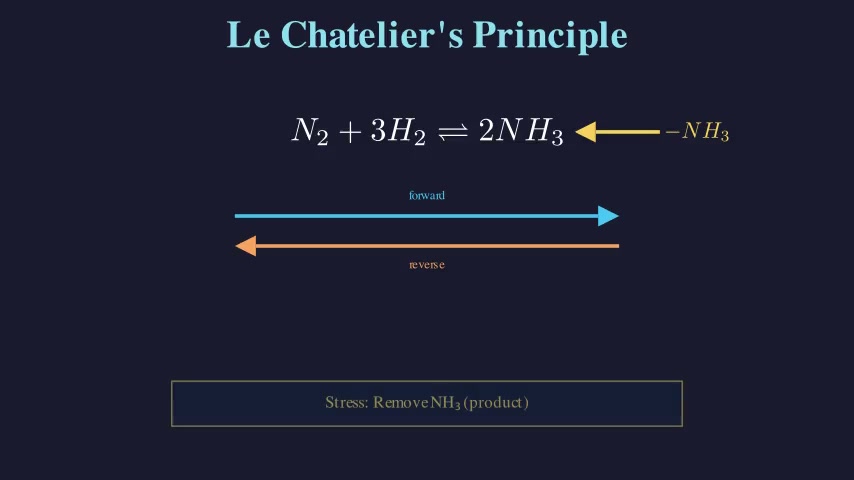
Demonstrates Le Chatelier's Principle using the Haber process (N₂ + 3H₂ ⇌ 2NH₃). Shows three stresses applied to a system at equilibrium and how the equilibrium position shifts in response to each stress using arrow-size animations.

High SchoolChemistry
The pH Scale

The pH Scale

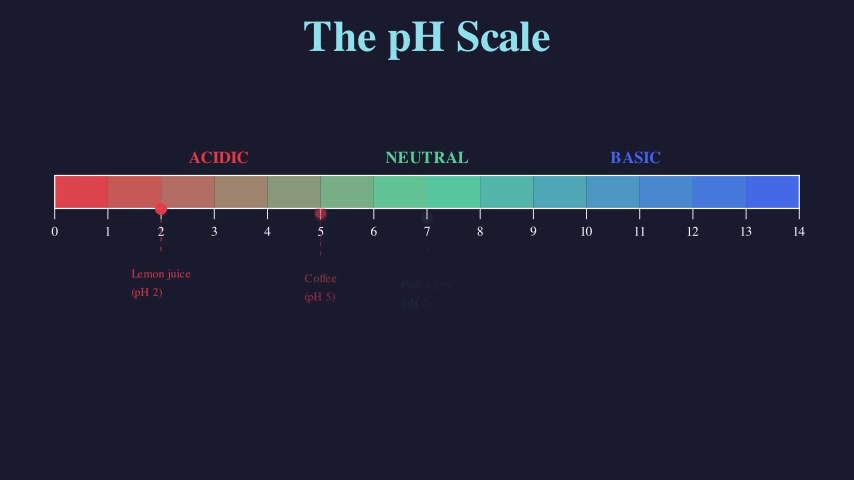
Introduces the pH scale from 0 to 14 with a color-gradient bar and real-world substance examples. Explains the logarithmic relationship between pH and hydrogen ion concentration, and animates how H⁺ concentration changes across the scale.

High SchoolChemistry
Covalent Bonding — Electron Sharing

Covalent Bonding — Electron Sharing

Demonstrates covalent bonding by showing two hydrogen atoms sharing electrons to form H₂, then extends to water (H₂O) where oxygen shares electrons with two hydrogens. Electron clouds overlap to illustrate shared pairs.

MiddleChemistry
Ionic Bonding — Electron Transfer

Ionic Bonding — Electron Transfer

Visualizes ionic bonding by showing how sodium donates its single valence electron to chlorine. The resulting oppositely charged ions attract each other to form NaCl. Electron shell diagrams and LaTeX equations are shown at each step.

MiddleChemistry
Periodic Table Structure

Periodic Table Structure

Introduces students to the structure of the periodic table by showing the first three periods. Demonstrates how rows (periods) correspond to electron shells and columns (groups) indicate valence electrons, using Na and Cl as worked examples with Bohr-model shell diagrams.

MiddleChemistry
Atoms & Molecules

Atoms & Molecules

A visual introduction to atoms and molecules for primary school students (ages 6–11). Shows how atoms (tiny building blocks) combine to form molecules, using water (H₂O) as the main example. Key takeaway: everything is made of tiny particles called atoms, and when they join together they make molecules.

PrimaryChemistry
States of Matter as Particle Speed

States of Matter as Particle Speed

Shows how the three states of matter differ at the particle level. Solid particles vibrate tightly in place, liquid particles flow loosely, and gas particles fly freely. A thermometer rises as heat is added to drive each transition.

PrimaryChemistry
Big-O Complexity

Big-O Complexity

Plots growth curves for the six major Big-O complexity classes on a shared set of axes. A ValueTracker animates n growing, showing how quickly each curve diverges. A reference table maps each complexity to example algorithms.

High SchoolCs
Binary Search

Binary Search

Demonstrates binary search on a sorted array of 16 numbers searching for the value 42. Each step highlights the middle element, eliminates half the array, and a step counter shows the logarithmic efficiency versus linear search.

High SchoolCs
Bubble Sort

Bubble Sort

Visualizes bubble sort on an array of 8 colored bars of different heights. Adjacent comparisons trigger swap animations highlighted in orange. Pass and swap counters update live. The O(n²) complexity is displayed after sorting completes.

High SchoolCs
BFS vs DFS Graph Traversal

BFS vs DFS Graph Traversal

Shows an 8-node undirected graph and demonstrates two traversal strategies: BFS spreads level by level using a queue, while DFS dives deep using a stack. Visited nodes are colored and the visit order is displayed for each strategy.

High SchoolCs
Hash Tables

Hash Tables

Demonstrates hash tables by animating the hash function that maps a key to a bucket index, inserting multiple key-value pairs, performing a lookup, and resolving a collision using chaining.

High SchoolCs
Recursion & the Call Stack

Recursion & the Call Stack

Animates the recursive computation of factorial(4), showing a visual call stack that grows as recursive calls are made and then unwinds as each frame resolves. The base case is highlighted, and final computed values propagate back up the stack.

High SchoolCs
Arrays

Arrays

Introduces arrays as a row of numbered boxes. Shows storing values, accessing elements by index, iterating with a moving pointer, and appending an element at the end.

MiddleCs
Boolean Logic Gates

Boolean Logic Gates

Introduces AND, OR, and NOT logic gates using standard gate symbols. For each gate, the truth table is animated row by row, with input/output wires lighting up green (1/true) or red (0/false). A bonus NAND gate is shown as the combination NOT(AND).

MiddleCs
Conditionals & Loops

Conditionals & Loops

Demonstrates two fundamental control flow structures: the IF/ELSE conditional (is it raining?) and the WHILE loop (counter < 5). An animated flowchart shows each decision diamond, paths, and the loop-back arrow. The counter increments visually on screen.

MiddleCs
What is a Function?

What is a Function?

Illustrates the concept of a function as a "machine" that takes an input and produces an output. Shows the double() function called multiple times with different inputs, demonstrates reusability, and briefly connects to mathematical function notation.

MiddleCs
Binary Numbers

Binary Numbers

Introduces binary numbers using the metaphor of light switches that are either off (0) or on (1). Students see how combinations of 4 switches represent decimal numbers and how counting works in binary from 0 to 3.

PrimaryCs
Algorithms: Step-by-Step Instructions

Algorithms: Step-by-Step Instructions

Introduces the concept of an algorithm using the relatable example of making a peanut butter sandwich. Each step appears in a flowchart-style sequence, reinforcing that an algorithm is a precise, ordered set of instructions that computers follow exactly.

PrimaryCs
What is a Computer?

What is a Computer?

An introduction to computers for primary school students (ages 6–11). Shows the core concept of input → process → output as a simple pipeline, using everyday examples like a calculator and a video game. Key takeaway: computers take in information, do something with it, and give back a result.

PrimaryCs
A* Pathfinding

A* Pathfinding

Demonstrates the A* search algorithm on a grid map with obstacles, navigating from source S to goal G. Shows the f=g+h cost function for each cell, contrasting the open set (frontier) and closed set (visited), and how the heuristic guides the search more efficiently than BFS. The final path is highlighted in gold.

Software EngineerCs
B-Trees & LSM-Trees (Database Indexes)

B-Trees & LSM-Trees (Database Indexes)

Contrasts two major database index structures used in production systems. B-trees are shown with multi-key nodes, branching factor, and range scan animation. LSM-trees show the write path from memtable through SSTable levels, and the read path checking multiple levels. Use cases are labeled clearly.

Software EngineerCs

Action Potential — Neuron Firing

A neuron diagram with a voltage-time graph showing all phases of an action potential. Ion animations (Na+ rushing in, K+ rushing out) are synchronized with the graph. The signal propagates down the axon at the end.

High SchoolBiology
Natural Selection

Natural Selection

A visual simulation of natural selection showing a population of bugs on a background. Camouflaged bugs survive while conspicuous bugs are removed by predators. Over three generations the population frequency shifts toward the camouflaged trait, tracked by a live bar chart.

High SchoolBiology
Protein Synthesis: Transcription + Translation

Protein Synthesis: Transcription + Translation

A two-phase animation of the central dogma. Phase 1 shows transcription inside the nucleus: DNA unzips and mRNA is synthesized. Phase 2 shows translation at the ribosome: tRNA delivers amino acids matching mRNA codons and the protein chain elongates.

High SchoolBiology
DNA Double Helix

DNA Double Helix

An animated construction of the DNA double helix, starting from two parallel backbone strands and progressively adding base pairs. The structure then twists into the recognizable double helix and base pairing rules are displayed.

MiddleBiology
Mitosis — Cell Division

Mitosis — Cell Division

Step-by-step visualization of mitosis showing all six major phases. Each phase is clearly labeled and the key cellular events are animated with colored chromosomes and nuclear envelopes.

MiddleBiology
Cell as a City

Cell as a City

An introduction to cell biology for primary school students (ages 6–11) using the analogy of a city. Each organelle is compared to a city building or service to make it memorable. Key takeaway: a cell is like a tiny city, with different parts doing different jobs.

PrimaryBiology
Photosynthesis

Photosynthesis

A visual walkthrough of photosynthesis showing sunlight, CO2, and water entering a leaf and being converted into glucose and oxygen. The reaction equation is displayed alongside the animation to tie the visual to the chemistry.

PrimaryBiology