Logo AnimGAnimG

Esplora esempi Manim della community

Sfoglia esempi Manim pubblicati, esempi di animazioni matematiche e idee riutilizzabili create dalla community AnimG.

Unit Circle Visualization of Sine Cosine Tangent Cotangent

Unit Circle Visualization of Sine Cosine Tangent Cotangent

A dark‑mode animation draws the coordinate axes and unit circle, sweeps an angle from the positive x‑axis, and highlights the horizontal and vertical projections as cosine and sine. It then shows the tangent line at (1,0) to illustrate tangent length and the tangent line at (0,1) for cotangent, emphasizing their ratios to sine and cosine. The scene fades out, leaving the four key segments labeled.

trigonometryunit-circlegeometry
Minh Hiếu HoàngMinh Hiếu Hoàng
Vector Length Growth Illustration

Vector Length Growth Illustration

A short animation shows a two‑dimensional vector starting at the origin with length one unit and a fixed direction. Over a few seconds the arrow smoothly extends to three units while the grid stays static, highlighting how a vector's length represents its magnitude. The final vector holds briefly before fading out.

vectorslinear-algebra
Omar EspitiaOmar Espitia
Finding the General Term of a Quadratic Sequence

Finding the General Term of a Quadratic Sequence

The animation shows a decreasing sequence, computes its first and second differences, identifies a constant second difference, and derives the explicit quadratic formula for the nth term. It solves for the coefficients using three terms, reveals the final expression, and verifies it against the original numbers.

sequencesquadraticdifference-method
pillayashley80
Factoring a Quadratic Equation Step by Step

Factoring a Quadratic Equation Step by Step

The animation walks through solving the equation x squared plus 5x plus 6 equals zero by factorisation. It shows the problem, identifies the method, finds two numbers whose product is 6 and sum is 5, splits the middle term, groups and factors, applies the zero-product property, solves for x, and verifies the solutions.

quadratic-equationsfactorisationalgebra
EO TP KalghatagiEO TP Kalghatagi
Building All Logic Gates From a Single NAND

Building All Logic Gates From a Single NAND

The animation shows how one NAND gate can implement the NOT, AND, and OR functions. First, tying both inputs of a NAND creates a NOT gate; next, two NANDs are arranged to produce an AND gate; finally, using De Morgan’s method each input is inverted with a NAND‑based NOT and the inverted signals feed a third NAND to yield an OR gate. Signal lines animate with yellow for logic 1 and blue for logic 0, and the corresponding Boolean expression appears as a caption.

nand-gateslogic-gatesdigital-logicdemorganboolean-algebra
Ahmet OrtaçAhmet Ortaç
Hand drawn rectangle with variable width

Hand drawn rectangle with variable width

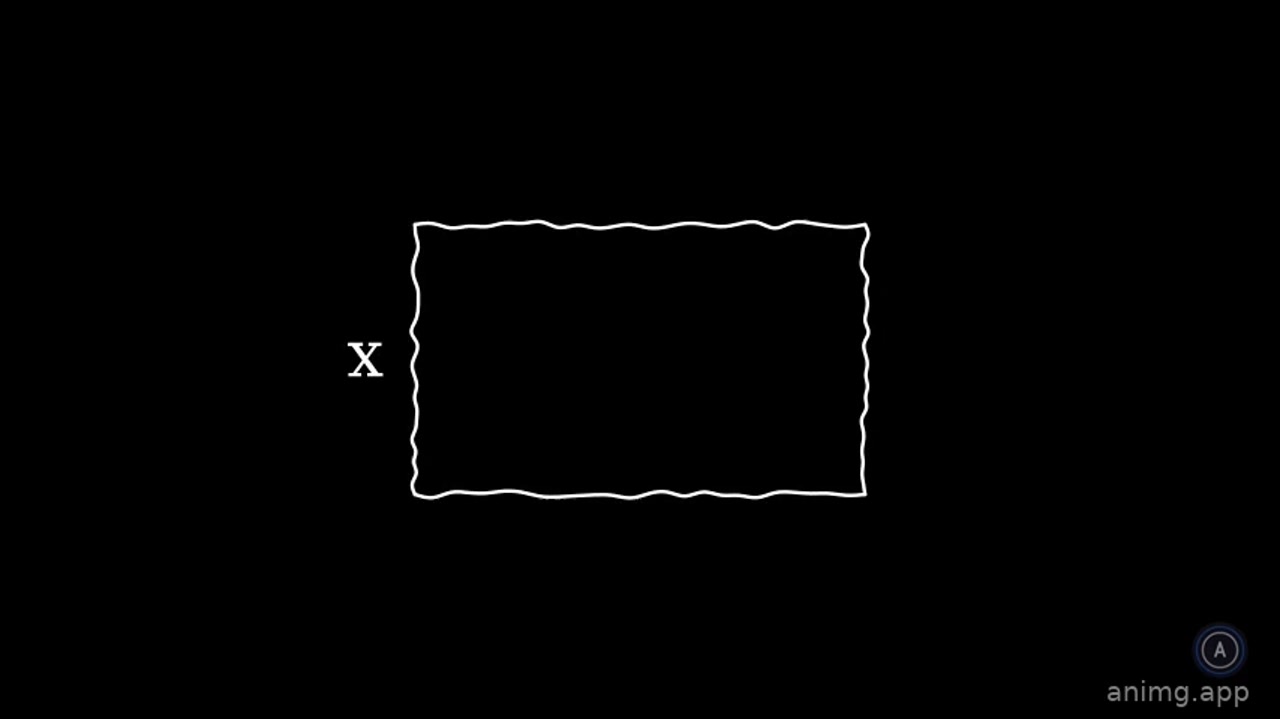
A 13 second minimalist animation shows a white chalk style rectangle on a black background. The vertical side is labeled x and the horizontal side is labeled 23 minus 2x. Labels appear handwritten. After drawing and labeling, the camera slowly zooms toward the rectangle, keeping the focus on the dimensions.

geometryalgebraminimalist
Dani FahimDani Fahim
Hand-drawn Rectangle Showing Width 23 Minus 2x and Height x

Hand-drawn Rectangle Showing Width 23 Minus 2x and Height x

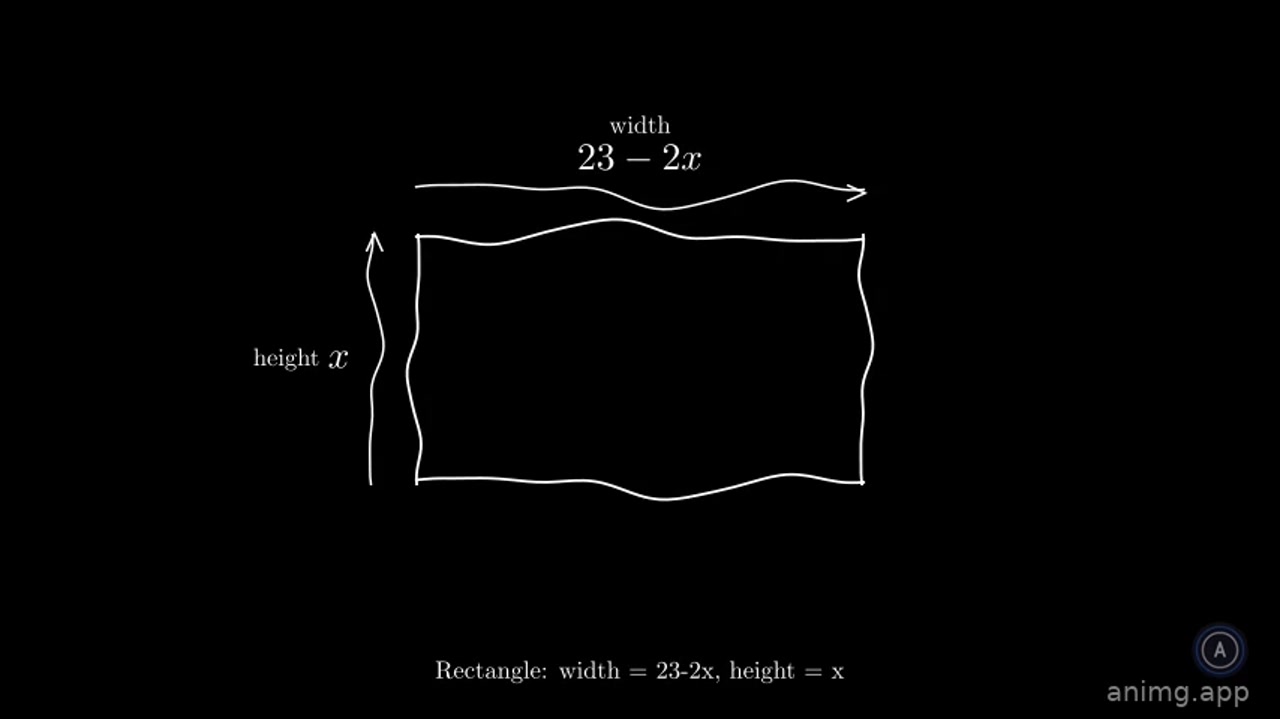
A minimalist blackboard animation draws a white hand‑sketched rectangle, then adds handwritten arrows labeling the top edge as width twenty‑three minus two x and the left edge as height x, followed by a slow zoom toward the rectangle and a fade out.

geometryalgebrahand-drawnrectangles
Dani FahimDani Fahim
Unit Circle Point Traces a Sine Wave

Unit Circle Point Traces a Sine Wave

A point moves counter‑clockwise around a unit circle while a vertical line projects its height onto a separate graph. As the point completes one full rotation, the projected height draws a sine wave in real time. The animation ends with the completed wave highlighted and a label indicating the sine relationship.

trigonometryunit-circlesine-function
Ashish VankudreAshish Vankudre
Equal Height and Angle in Two Right Triangles
Matematica

Equal Height and Angle in Two Right Triangles

The animation shows two parallel columns with sunlight rays forming two congruent right triangles on a ground line. The columns slide together and apart while a short tick mark indicates equal heights. Brief flashes of the rays highlight their parallelism, and small arcs appear at the right‑angle corners to denote equal angles. All symbols appear without captions and fade out at the end.

geometryright-trianglesequal-anglesequal-heights
Trang HoàngTrang Hoàng
Fundamental Theorem of Arithmetic Visual Proof

Fundamental Theorem of Arithmetic Visual Proof

The animation introduces the Fundamental Theorem of Arithmetic, then builds a factor tree for the number 60, highlighting each prime factor in blue. A second split-screen tree shows an alternative factoring order, and arrows demonstrate that the resulting multisets of primes are identical. The final frame displays the prime multiset and emphasizes that the factorisation is unique up to order.

number-theoryprime-factorizationvisual-proof
Brains R US Software ConsultancyBrains R US Software Consultancy
Jungle Rhythm: Sharing Doubles Happiness

Jungle Rhythm: Sharing Doubles Happiness

A short animation follows lonely monkey Miko meeting elephant Appu in a jungle. Miko plays with a strawberry, then shares it with Appur, sparking musical notes and a joyful bounce. Captions explain the moral that happiness grows when shared, ending with a fade‑out of the moral text.

storytellingmoralitysharing
Jagdeesh dhakarJagdeesh dhakar
Solving a Linear ODE with a Slope Field

Solving a Linear ODE with a Slope Field

A short animation displays a coordinate grid and a blue slope field for the differential equation dy/dx plus 2y equals e to the minus x. The equation slides in, then the integrating factor e to the 2x appears and transforms the left side into a single derivative while the right side becomes e to the x. Finally a bright red solution curve, y equals C e to the minus 2x plus one third e to the minus x, is drawn smoothly through the field.

differential-equationsslope-fieldintegrating-factor
Ryan KulibabaRyan Kulibaba