AnimG 标志AnimG

Physics animation videos

浏览精选的Physics动画示例,包含可复用的 Manim 场景、可视化讲解和可直接用于课堂的思路。

22 个动画

Circular Motion & Centripetal Force

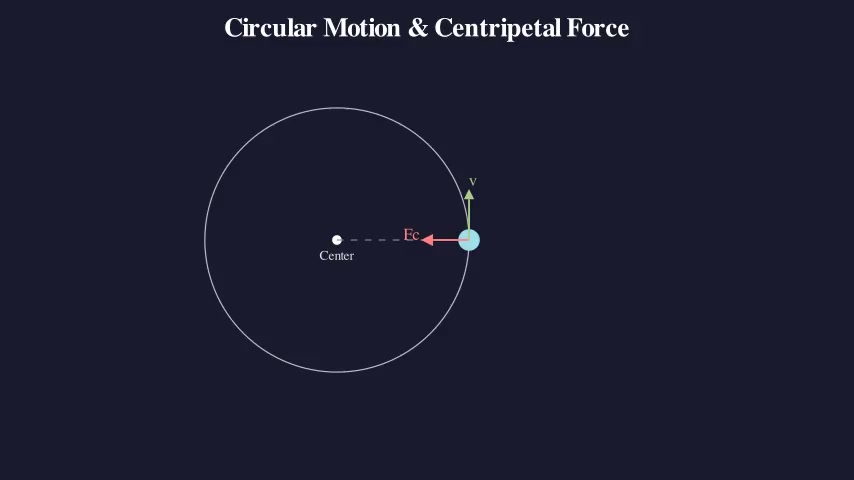
Circular Motion & Centripetal Force

A ball on a string orbits in a circle. The velocity vector (tangent) and centripetal force vector (inward) are shown continuously updating. When the string breaks, the ball flies off tangentially, illustrating why centripetal force is required.

Conservation of Momentum

Conservation of Momentum

Two collision scenarios on a frictionless surface demonstrate momentum conservation. An elastic collision shows ball 1 stopping and ball 2 moving on. An inelastic collision shows the balls sticking together. Momentum vectors p = mv are shown before and after each collision.

Electric Fields

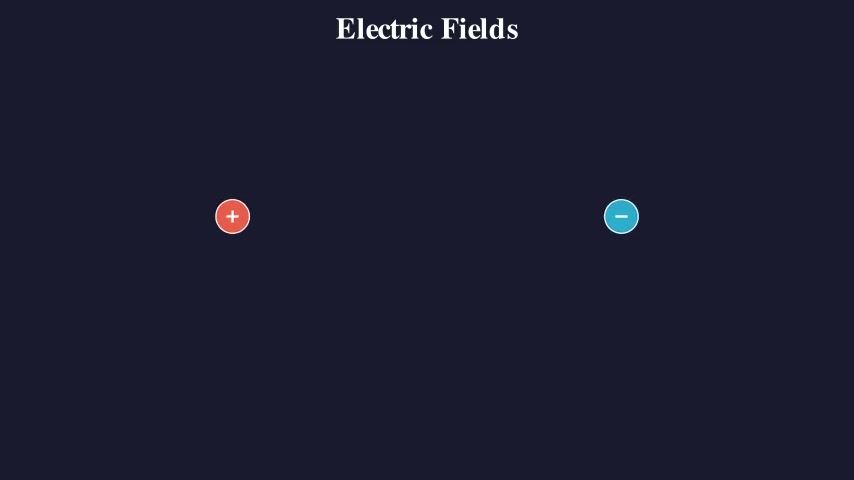
Electric Fields

Electric field lines are shown radiating from a positive charge and converging on a negative charge. A dipole field shows lines flowing from + to -. A test charge placed in the field experiences a force along the field line direction.

Ohm's Law — V = IR

Ohm's Law — V = IR

A water pipe analogy introduces voltage, current, and resistance intuitively. A circuit diagram then shows these quantities. Increasing voltage drives more current. A V-I graph shows the linear relationship.

Projectile Motion

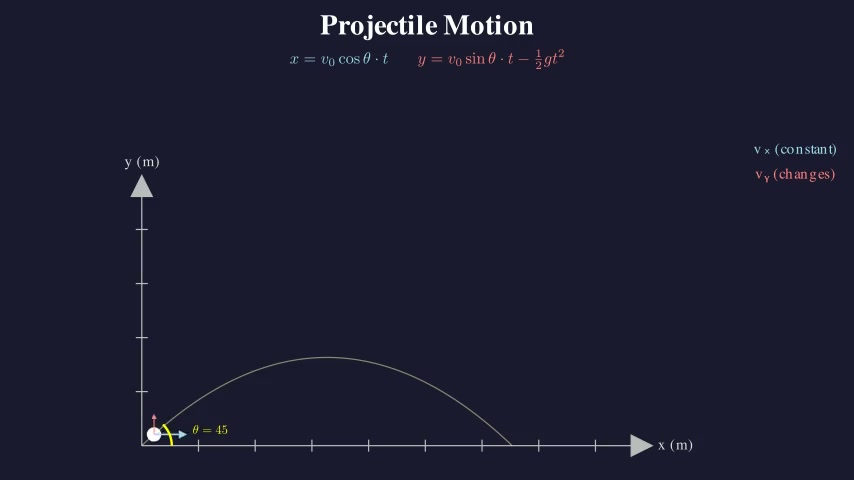
Projectile Motion

A projectile launched at an angle is decomposed into horizontal (constant velocity) and vertical (uniformly accelerated) components. The parabolic path is animated with a moving dot and changing velocity vector. Parametric equations are displayed.

Work & Energy: Potential → Kinetic

Work & Energy: Potential → Kinetic

A ball at height h rolls down a ramp, converting gravitational potential energy into kinetic energy. A synchronized bar chart shows PE decreasing and KE increasing while total mechanical energy remains constant.

Newton's First Law — Inertia

Newton's First Law — Inertia

A ball on a surface gradually stops due to friction; in frictionless space it rolls forever at constant speed. A car-braking inertia demo shows a passenger lurching forward. Label: "No net force = no change in motion."

Newton's Second Law — F = ma

Newton's Second Law — F = ma

A block on a frictionless surface is pushed by a constant force. Three scenarios demonstrate that the same force produces less acceleration on heavier blocks and more acceleration on lighter blocks. The formula F = ma is displayed with numerical examples.